Widen the Circle Berlin Fellowship 2026
Welcome to Widen the Circle's Berlin Fellowship! We are looking forward to the week we will spend together in Germany exploring issues that are central to understanding collective memory and the ways in which German and American societies have attempted to reconcile with their respective troubled pasts.
We have created an itinerary that will help the group understand Germany's history and how this history has been—and continues to be—dealt with on the local and national levels. (And we will continue to revise the itinerary and build upon it.) During our time together, we will hear from experts and visit some large, well-established sites that will give us important context. Many of the presenters you will be meeting have been involved with Widen the Circle and the Berlin Fellowship for the last few years. Your peers in this group have incredible skills, and your expertise will be integrated throughout the program in a stimulating, collaborative learning experience.
While engaging in these bigger conversations, we will also take time to focus on close-to-the-ground, unique local projects initiated by Obermayer Award winners. We will explore how Germany's efforts—from the broad national attempts as well as the small personal efforts to confront its past—have shaped German society, and continue to shape it at the current moment. We see how these efforts impact Germany’s growing Jewish community, increasingly diverse population, and Germany's geopolitical position in modern Europe and the world. We will take time to process this information and consider the applications of these lessons in a U.S. context.
We have created this information resource to share key details about the Berlin Fellowship trip. In the meantime, read through this webpage, ask us questions, and get yourself prepared for a rewarding week of exploration and discovery.
Preliminary Schedule
The following is a day by day overview of the week we’ll be spending together. Please note that it is subject to updates before departure.
We’d like to take a moment to again convey the collaborative nature of this program. Weaved throughout the agenda are expert talks, participant-facilitated sessions, and group debriefings that will bring together all of your voices in what we hope is a truly inclusive and enlightening experience. The facilitators are actively working to craft a space for learning that is specifically prepared with our group in mind, as well as flexible and responsive enough to accommodate the conversations and ideas we have yet to explore together.
Wednesday, June 3rd: Arrival Day—Welcome to Berlin!
Willkommen! At 5pm, we’ll go on a short walking tour of the neighborhood around the hotel (which has important historical significance for the goals of the program). With the aim of getting our bearings, we’ll visit the Museum Island and the Hackescher Höfe. Please meet in the lobby at 4:45pm.
Thursday, June 4th: Let’s get started! Orientation and Introductions.
Start time: 9:30am in the lobby.
On our first full day, we’ll get started with a general orientation, which will include contracting, a detailed look at the agenda, and time for participants to get to know each other. We’ll hear an overview talk that will provide historical context to the conversation about memory culture in Germany and in the U.S.
In the late afternoon we’ll stretch our legs and take a walking tour of the Jewish Quarter, deepening our understanding of Jewish life in Berlin before, during, and after the Holocaust. We’ll end at a local restaurant for a group dinner.
Approximate end time: 8:00pm
Friday, June 5th: Memorials and sites of remembrance (and reflection) in modern Germany.
Start time: 8:45am
In the morning we’ll visit the Memorial to the Murdered Jews of Europe and explore the exhibition hall underground. Over lunch, we’ll debrief and check in as a group.
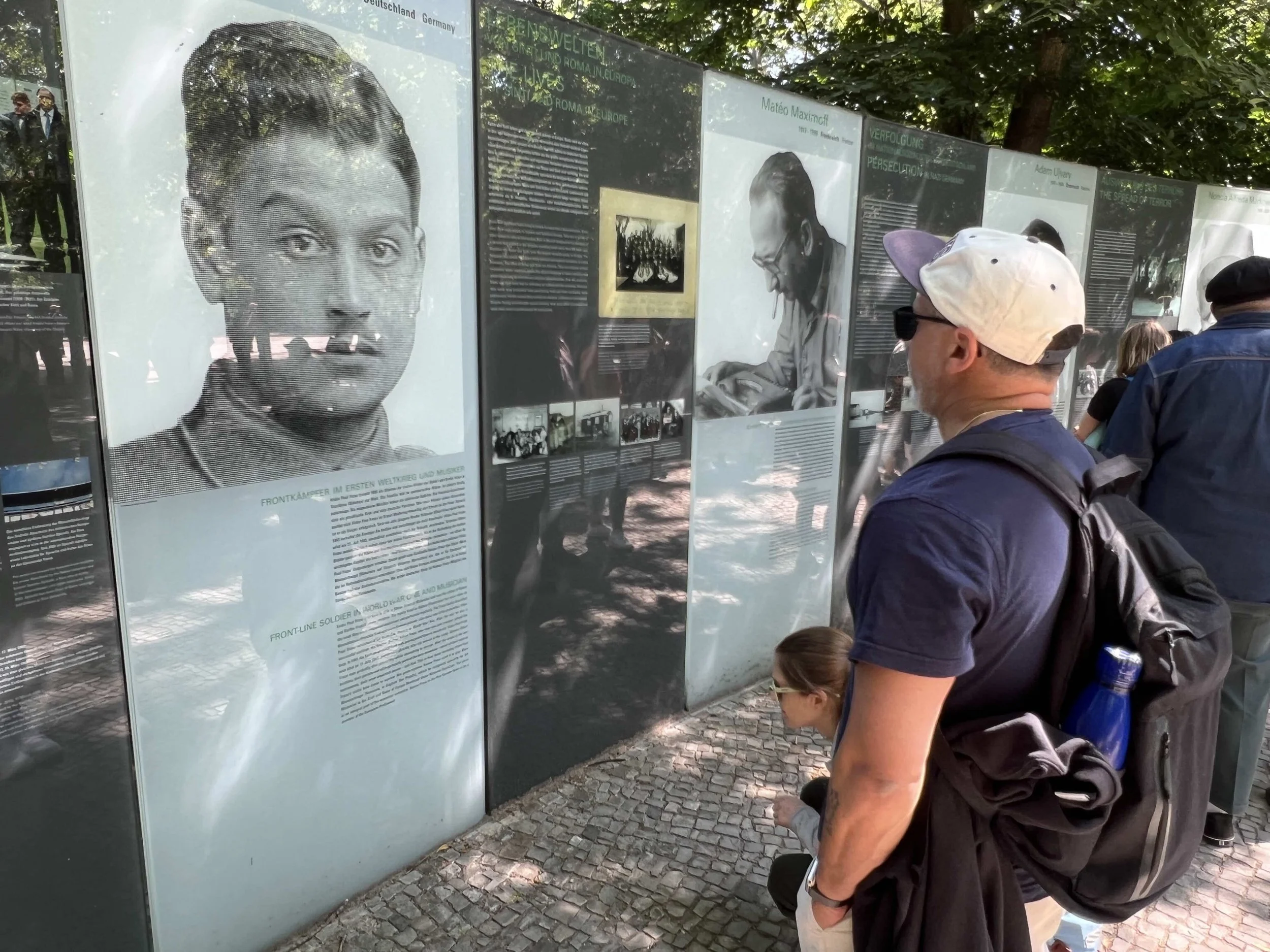
In the afternoon, we will see the Reichstag and a number of the other memorials and important locations in the city center, including those dedicated to the Roma and Sinti and homosexual communities. Together we’ll see what physical memorial culture looks like in modern Germany, and gain an intimate understanding of what it took to arrive at this point.
We will end the day with a visit to the neighborhood of Kreuzberg to learn about the vibrant cultural and community center being built at the Fraenkelufer Synagogue.
Free evening (from approximately 6:45pm).
Saturday, June 6th: Grassroots engagement with history and a special evening with the Widen the Circle Network.
Start time: 8:45am
In the morning we’ll meet a diverse group of high school students and alumni who will show us a deportation site and community memorial they helped establish, before having the chance to meet and exchange with the students over lunch.
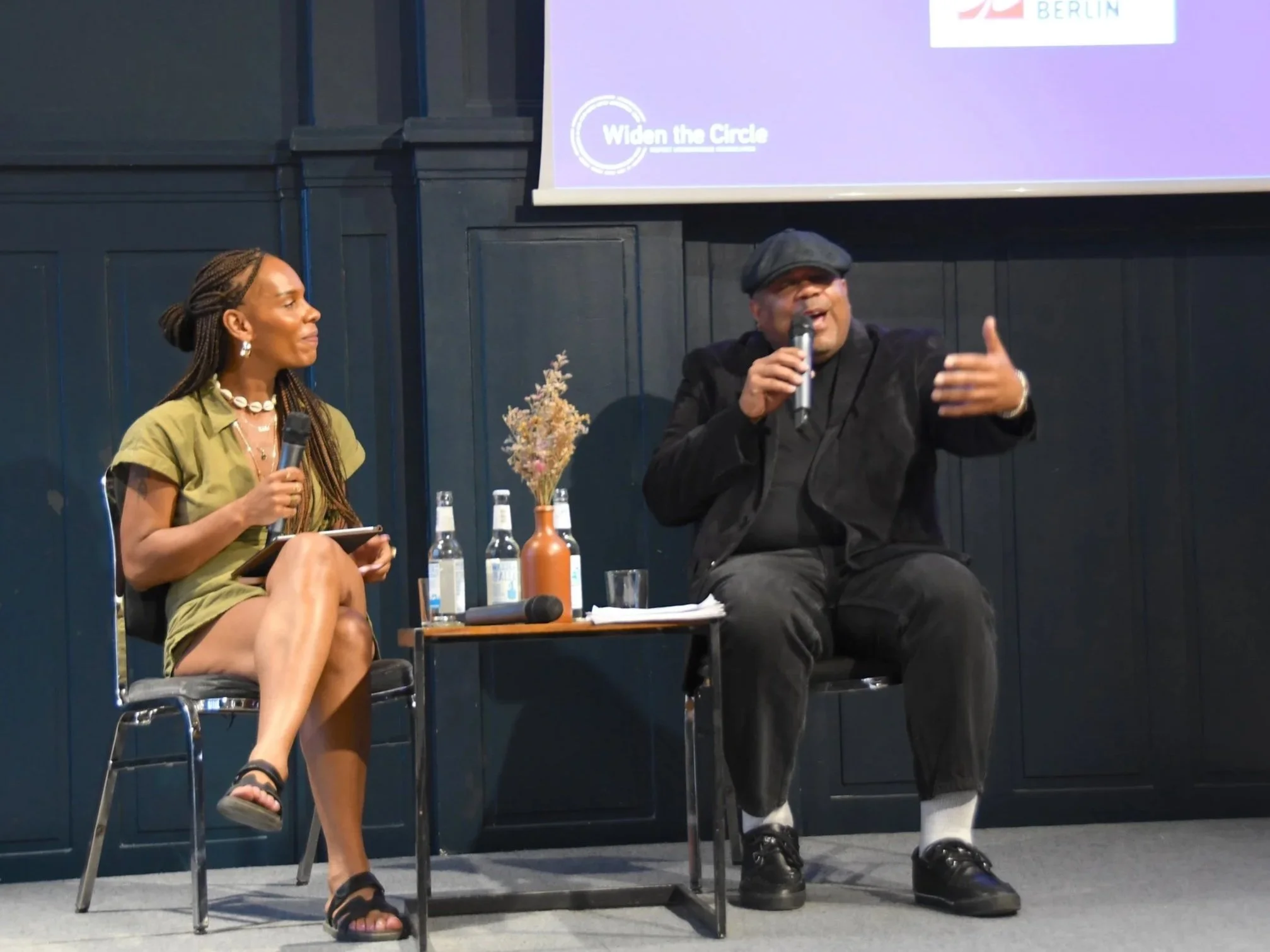
After we return to the hotel, we will hear from Makda Isak, a scholar and educator whose work centers on anti-racism, post-colonial continuities, and the experiences of Black and marginalized communities in Germany. We will hear from her and have a chance to debrief the morning’s visit.
We will spend the evening at the Widen the Circle Summer Forum for the keynote presentation. We’ll dine together with the participants from around Germany, engaging with members of the network and giving you the opportunity to interact with many of them in a friendly exchange.
Approximate end time: 9:30pm
Sunday, June 7th: WtC Summer Forum workshops.
Start time: 9:00am
Today we’ll return to the Summer Forum for a panel discussion and a workshop, once again mixing with German network members who will share their reflections and experiences with us.
We will end the day with an afternoon group debrief at the hotel.
Free evening (approximately from 5pm).
Monday, June 8th: Germany beyond the big cities.
Start time: 8:00am
This morning we will visit the Sachsenhausen Concentration Camp, a former Nazi concentration camp that now serves as a memorial and museum documenting the persecution and imprisonment of tens of thousands under the Nazi regime.
In the afternoon we will leave Berlin to visit a project of an Obermayer Award-winning organization in the state of Brandenburg. We will spend the first half of the day learning about their work, the challenges they face as a small organization in the former east Germany, and taking a deep dive into some of the realities of memory work at the grassroots level outside of the big cities.
Approximate end time: 9:30pm
Tuesday, June 9th: Memory work in action.
Start time: 9:00am
On our penultimate program day, we’ll spend the morning in a former Jewish neighborhood in west Berlin. We will have the chance to visit the Löcknitz School, an elementary school, and learn about their innovative memory work that takes place in site, a project that inspired Bryan Stevenson during a visit to Germany many years ago.
In the afternoon we’ll visit the apartment of Marie Rolshoven, one of this year’s fellows, director of Denk Mal am Ort (Think About This Place), and a 2024 Obermayer Award winner. Once a year, residents in Berlin, Hamburg, Munich, and Frankfurt open their homes to share stories of former inhabitants—Jews and others persecuted by the Nazis or members of the resistance. This powerful project began with stories told in Marie’s apartment. She will share the program’s growth and impact, along with the history of her home.
In the evening, you will have the opportunity to attend a film premiere featuring Dr. Karlos Hill, our co-facilitator, and Joy Banner, one of this year’s fellows, following young remembrance activists as they travel from Berlin to New Orleans to explore the legacies of slavery, colonialism, and racism.
Free evening (approximately from 6pm if not attending film, or 8pm if attending).
Wednesday, June 10th: Working with the past, towards a better future. Closing remarks.
Start time: 9:00am
As we conclude our program, we’ll take the day to discuss what we’ve learned together and how it might influence our work when we return home.
After some free time we’ll come together for a final celebratory dinner before saying our goodbyes.
Approximate end time: 9:30pm
Thursday, June 11th
Depart independently, no official programming. Auf Wiedersehen!
Guiding Questions
The Berlin Fellowship will be structured around four core questions. They are the touchstones that we will return to throughout the trip, allowing us to explore the connections between Germany and the United States, as well as how each country has confronted history and memory.
Role of remembrance: What roles do history and remembrance play in today’s Germany and in the U.S., and what are effective strategies for putting the two histories in conversation with one another?
Impact of local projects: How have local projects created by individuals and groups throughout Germany and the U.S. confronted the past, kept memory alive, and contributed to healing from such profound historic injustice, helping to fight against bigotry and against those who resist the idea of remembering?
From remembering to action: How do we go from remembering to action, and how do we take advantage of remembrance at the present moment to collectively create robust responses to the challenges we face?
Present climate: Considering the current political climate in the U.S. and Germany, how do we refine our strategies for doing this work, and how do we support one another and collaborate as part of a larger network of remembrance activists?
Media List
Below is a list of books, articles, podcasts, and other media that we feel are important resources as you prepare for our program together. We understand that you have limited time before we come together in June, so we’ve focused our required media on a small number of core items, supplemented by additional optional resources.
These materials are intended to provide a shared foundation for our conversations. They are not meant to offer comprehensive coverage, but rather to introduce key questions about how societies remember and interpret the past.
To help pace this preparation, we’ve organized the required materials around our three orientation sessions. We ask that you complete the assigned items in advance of each session.
For Orientation Session 1: Monday, April 27
Deutsche Welle (DW) short film on remembrance culture in Germany (12 minutes)
Germany’s post-war history has largely been shaped by its commitment to democratic principles and an evolving approach to confronting the past. This short film provides an overview of the current landscape, including the challenges faced by remembrance activists today amid the rise of far-right ideologies that seek to diminish or reinterpret this history.
For Orientation Session 2: Thursday, May 7
Brennan Center for Justice: Conversation with Clint Smith
This one hour conversation, based on Smith’s book How the Word Is Passed, explores sites of slavery and remembrance in the United States. It highlights how historical spaces function as contested sites of memory and offers a lens for thinking about public history, narrative, and responsibility.“How Hitler Dismantled a Democracy in 53 Days” by Timothy W. Ryback in The Atlantic
This article traces the rapid erosion of democratic institutions in Germany in 1933. It provides historical grounding for understanding how systems of power, complicity, and authoritarianism can develop, offering important context for our discussions.
For Orientation Session 3: Wednesday, May 20
Chapter 7 from Learning from the Germans by Susan Neiman
This piece touches on several of the themes we will explore. Neiman’s work is one of the most widely discussed in the U.S. on these topics, and the book is available at many libraries, online book sellers, and as an audiobook. We recommend reading this chapter as a starting point, while also keeping in mind that there are many differing perspectives on remembrance culture. Here is a short accompanying critique, written by Neiman a few years after the book’s publication, reflecting how her thinking has evolved over time and in response to global events, and helping to frame the debates around her arguments.“What is Memory Culture?: Look at the process, not the outcome” by Jenny Wüstenberg (Goethe Institut)
This short piece focuses on the critical role local activists in Germany played in reckoning with the past, creating what Wüstenberg describes as a decentralized “landscape of memory.” As we will see, many of these activists are Obermayer Awardees, and their work offers an important lens for understanding how remembrance develops over time. (This was shared with you as an attachment via email. Please contact us if you cannot find it.)
Optional Materials
The materials below are optional and intended for those who would like to explore these topics in greater depth. They are not required, and we do not expect you to review them in full—rather, we encourage you to engage with anything that feels most relevant or interesting to you.
Any questions, curiosities, or requests for further recommendations can be directed towards Bryan and Rebecca.
Present day Germany and contemporary issues
Article — “Germany’s Holocaust Memory Problems” from Georgetown Journal of International Affairs, 2022: This article offers a critical perspective on Germany’s widely praised approach to Holocaust remembrance, examining its limitations and ongoing tensions. It raises questions about whose histories are centered, how memory culture adapts to a more diverse society, and whether aspects of Germany’s model risk being oversimplified or instrumentalized. The piece provides an important counterpoint to more celebratory narratives, helping to frame some of the debates around the scope and future of remembrance culture.
Article — “Elon Musk's call for Germany to 'move beyond' Nazi guilt is dangerous, Holocaust memorial chair says” from NBC News, 2025: After Elon Musk’s repeated endorsement of Germany's far-right AfD party and his remarks that downplay the country's Nazi past, the chairman of Israel's Holocaust memorial criticized him, calling it an insult to Holocaust victims and a threat to Germany's democratic future.
Article — “Israel and the delusions of Germany’s ‘memory culture’” The Guardian, 2025: Germany's complex post-WWII relationship with Israel and its own history of guilt and memory culture is marked by a paradox of philosemitism, political expediency, and the resurgence of far-right nationalism, which complicates its stance on both the Holocaust and contemporary issues like the Israeli-Palestinian conflict.
Article — “Berlin Was a Beacon of Artistic Freedom. Gaza Changed Everything” from The New York Times, 2024: This article gives some insight into the complexities of the current moment politically and culturally in Berlin, as the implications of Germany's history and memory culture reverberate through the city's renowned arts scene.
Podcast — Day X, Part 2: “In the Stomach” from The New York Times, 2021: About a right wing officer in the German army who planned a series of assassinations. This part explores antisemitism and the growth of neo-Nazis via the life of one of his targets, leading human rights activist Anetta Kahane.
Article — “No Place for Hate: Jens-Christian Wagner” EVZ Foundation, 2023: Prof. Dr. Jens-Christian Wagner links rising attacks on memorial sites to the political shift rightward and stresses the need for democratic parties to oppose extreme-right narratives and promote historical awareness.
Article — “Germany Agrees to Pay Namibia for Colonial-Era Genocide” from The New York Times, 2021: This article examines Germany’s formal acknowledgment of the genocide of the Herero and Nama peoples and its agreement to provide financial support framed as development aid rather than direct reparations. It highlights criticism from affected communities, who argue the response falls short of meaningful accountability, raising broader questions about recognition, responsibility, and how societies confront colonial violence.
German-Jewish History and the Holocaust
Podcast — Being Jewish in Germany — What does that look like as the country marks 1,700 years of Jewish life? From KCRW Common Ground Berlin, 2021: Marking 1700 years since the arrival of the first Jews in Germany, a series of interviews with young people shines light on the state of the community in modern Germany. One of those interviewed in this podcast will be a speaker at the 2024 Widen the Circle Summer Forum we will attend on Saturday night.
Book — The Holocaust: A New History, by Laurence Rees, 2017: Provides a sweeping overview of the Holocaust that is useful for anyone looking for some foundational history.
Book — Learning from the Germans: Race and the Memory of Evil, by Susan Neiman, 2019: Explores perspectives on how a country can come to terms with its historical wrongdoings. Neiman is a white woman who came of age in the civil rights-era South, and a Jewish woman who has spent much of her adult life in Berlin. (*Ch.7 is required reading)
Book – The Holocaust: an Unfinished History, by Dan Stone, 2024: Spanning the entirety of the Holocaust. Stone reveals how the idea of 'industrial murder' is incomplete, and he outlines the depth of collaboration across Europe, arguing persuasively that we need to stop thinking of the Holocaust as an exclusively German project. He also considers the nature of trauma the Holocaust engendered, and why Jewish suffering has yet to be fully reckoned with. And he makes clear that the kernel to understanding Nazi thinking and action is genocidal ideology, providing a deep analysis of its origins.
American History and Memory
Article — “Panels at Philadelphia’s President’s House Confront Slavery in Washington’s Household” from The Philadelphia Inquirer, 2026: This article examines new interpretive panels at the President’s House site in Philadelphia, which more fully acknowledge the lives of the enslaved people held by George Washington while he served as president. It highlights ongoing efforts to present a more complete and honest public history, as well as the tensions and debates that can arise when revisiting national narratives and founding figures.
Article — “The War on History Is a War on Democracy” from The New York Times, 2021: Scholar of totalitarianism Timothy Snyder examines recent efforts to restrict how race and history are taught in American schools. It situates these developments within a broader historical context, highlighting parallels to past attempts in Europe to control historical narratives for political ends.
Article — “Trump Calls on Smithsonian Institution to Promote ‘American Greatness’,” from The New York Times, 2025: Documents President Trump’s executive order to reshape the Smithsonian Institution by promoting a more positive view of American history while criticizing what he sees as a “revisionist movement” that portrays the nation’s past negatively. His directive seeks to limit funding for exhibitions that address race, gender, and other complex historical narratives, favoring a focus on “American greatness.”
Article — “Republicans Tear Down a Black Lives Matter Mural,” from The Atlantic, 2025: The removal of the Black Lives Matter Plaza mural in Washington, D.C., highlights the shifting political landscape under President Trump’s return to office, underscoring the vulnerability of racial justice and history work under the current administration despite its past acts of defiance during the racial justice protests of 2020.
Video — “Fomenting Antisemitism” SubStack, 2025: Timothy Snyder argues that recent efforts to defund American higher education under the guise of fighting antisemitism are themselves antisemitic, misusing the term as a political tool and undermining its true meaning.
Article — “Bryan Stevenson Reclaims the Monument, in the Heart of the Deep South” from The New Yorker, 2024: A piece on civil-rights attorney Bryan Stevenson’s new Freedom Monument Sculpture Park, which aims to show the realities of enslavement on a monumental scale.
Video — “Why All Americans Should Honor Juneteenth" from Vox, 2020: Explores the true story behind Juneteenth, highlighting the delayed emancipation of enslaved people in Texas and why understanding this history is essential to recognizing slavery’s lasting impact on America.
Video — “Alabama sculpture park evokes history of slavery.” CBS Sunday Morning, 2024: A visual visit to the Equal Justice Institute’s Freedom Monument Sculpture Park in Montgomery, AL, a powerful 17-acre site featuring nearly 50 sculptures by renowned artists.
Article/Video — “Trump administration's potential sale of historic civil rights site sparks outrage” ABC 3340, 2025: Highlights the Trump administration's proposal to sell or close over 400 federal properties, including the Montgomery Bus Station and the Freedom Rides Museum, highlights the threat facing historically significant civil rights landmarks.
Book — The 1619 Project: A New Origin Story, Ch. 10 by Bryan Stevenson, 2021 (focus on pgs. 275-283): Demonstrates how mass incarceration can be traced to the legacy of slavery due to a loophole in the 13th Amendment.
Book — How The Word Is Passed: A Reckoning With The History Of Slavery by Clint Smith, 2021: Exploration of the ways we talk about (and avoid talking about) slavery; blends reporting and deep critical thinking about history and memory.
Book — Caste: The origins of our discontents by Isabel Wilkerson, 2020: (focus on “Part 2 — The Arbitrary Destruction of Human Divisions,” Ch. 4–9.) Looks at U.S. and Nazi Germany as caste systems. Focus chapters delve into what Nazis learned from racist caste system in the U.S.
Documentary — 13TH on Netflix by Ava Duvernay & Jason Morgan, 2016: Documentary analyzes the systemic criminalization of African Americans and the U.S. prison boom.
Widen the Circle & the Obermayer Awards
Article — Widen the Circle, “The Obermayer Awards: A Brief History”: A one-page account of how the Obermayer Awards came to be.
Article — “Obermayer Awards overcome silence with stories of German-Jewish history” from The Christian Science Monitor, 2016: Arthur Obermayer's German Jewish history awards being forgotten lives to light, personalizing the past to heal communities today.
-
In Germany, pharmacists are trained to deal with minor medical issues, which they can often address on the spot. In addition, 24-hour pharmacies are very common in major cities. (The word for pharmacy in German is Apotheke.) Our hotel in Berlin is also located a 5-minute walk from a hospital, and there are several doctors’ offices nearby.
Medical emergencies should be directed immediately to the hotel reception, followed right away by the tour programing staff. In addition, “911” in Germany is “112” and is reachable from any phone.
For reference, the nearest hospital to our hotel in Berlin is:
Alexianer St. Hedwig-Krankenhaus
Große Hamburger Str. 5-11, 10115 BerlinIf you have any medical concerns the team should be aware of, please contact Rebecca.
Concerning COVID-19
Our aim during our time together is to provide the safest possible conditions and to minimize the risk of illness. We also hope to create an environment that is both comfortable and relaxed, allowing us to freely interact with each other and enjoy group participation.
We strongly recommend that all participants and Widen the Circle team members receive a booster shot within the last 12 months.
In the event that someone does test positive, we will follow recommended guidelines related to their quarantine period. We will make sure that the individual is comfortable in their room, with whatever support is needed. Program staff will be available to assist you.
-
The average temperature in Berlin in June is an average of 72 degrees Fahrenheit and temperatures typically fall between between 60 and 85 degrees Fahrenheit.
The Berlin Fellowship dress code is fairly casual. The dress code can be described as casual to smart casual. The Oxford dictionary defines smart casual as: “neat, conventional, yet relatively informal in style, especially as worn to conform to a particular dress code.” In other words, jeans and a nice t-shirt are completely fine. It is imperative that you wear comfortable, supportive shoes for walking.
Other things to bring: We recommend U.S. fellows bring an adapter or voltage converter for charging your devices. Please bring a raincoat or umbrella in case it rains. Please bring a reusable water bottle with you to fill up and stay hydrated!
-
The program is being coordinated by Rebecca Richards-Kramer and Bryan Fellbusch. If you have any questions, concerns, or comments about the trip, please contact them directly.
Rebecca Richards-Kramer
rebecca@obermayer.us
+1-781-783-5439Bryan Fellbusch
bryan@obermayer.us
+49 176 98343109Program participants must organize their own transportation from the Berlin airport to our hotel. The airport has one main exit where all buses, taxis, and Uber drivers are located. Ubers tend to be significantly cheaper than taxis. Please ensure you have the name and address of the hotel with you to present to your driver.
During the trip, we will stay in close contact via WhatsApp, an app where we can create a closed chat group just for program participants and staff. We will give you more details on this in May.
Hotel in Berlin:
Classik Hotel am Hackescher Markt. Große Präsidentenstraße 8 10178 Berlin
Our hotel is located near Hackescher Markt, between the S-Bahn Station Hackescher Markt and the U-Bahn Station Weinmeisterst.
-
For the dinners on your own or in case you’d like to get a late night snack, here are some restaurant suggestions in the area.
KOREAN
YamYam Berlin
Alte Schönhauser Str. 6, 10119 BerlinFRENCH/GERMAN
Brasserie Torbar
Torstraße 183, 10115 BerlinGERMAN
Gaststätte Sophieneck
Große Hamburger Str. 37, 10115 BerlinSCHNITZEL
Schnitzelei Mitte
Chausseestr. 8 Hinterhof 10115 BerlinGEORGIAN
Golden Fleece
Torstraße 69, 10119 BerlinBISTRO
Altes Europa
Gipsstraße 11, 10119 BerlinSUSHI
Kuchi Mitte
Gipsstraße 3, 10119 BerlinASIAN TAPAS
Transit
Rosenthaler Str. 68, 10119 BerlinVIETNAMESE
Monsieur Vuong
Alte Schönhauser Str. 46, 10119 BerlinManngo Vietnam-Restaurant
Mulackstraße 29, 10119 Berlin
About Widen the Circle
Widen the Circle works with people uncovering local history, history related to trauma and injustice, and using the lessons of that history to create a more just world today.
We believe that exposing local history related to hate and injustice — history told through the lens of community — is a powerful way to help individuals acknowledge and address that injustice today.
Our goal is to increase the impact of work being done at the grassroots level — community by community — by remarkable individuals and organizations in Germany and the United States.
“Every day, the haters and the aggressors of this world get the headlines in the newspapers. But that’s not the whole story. There are so many people full of love and tenderness and compassion and passion who try to do the right things, who try to make things right for the world. And who stand up every day against prejudice and hate.” — Gabriele Hannah, Obermayer Award winner