
Anasa Troutman
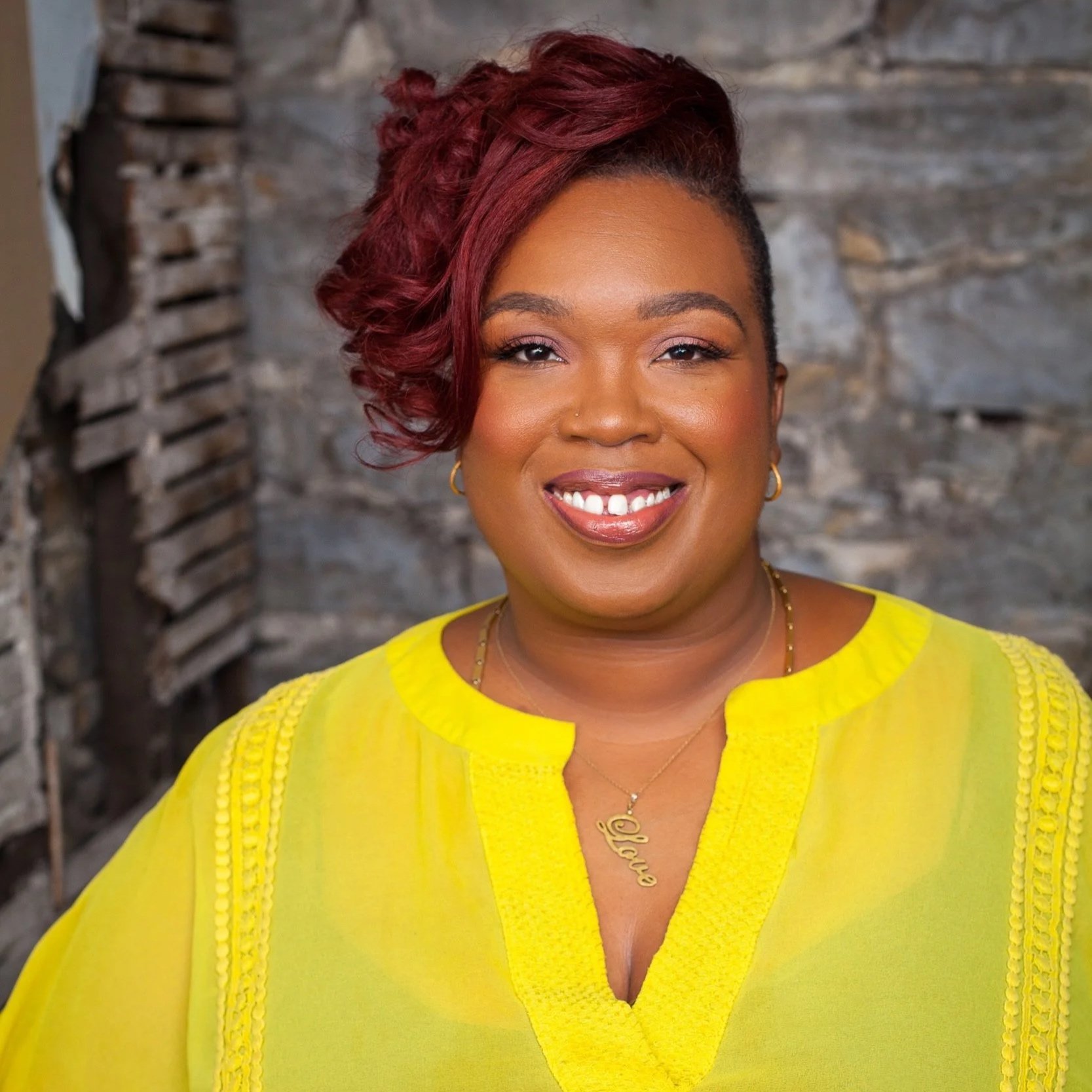
Anasa Troutman’s life has been about bringing people together, creating community, and not just preserving history but using it to build something stronger and better than existed before.
Still, it’s hard not to start with the heartbreak.
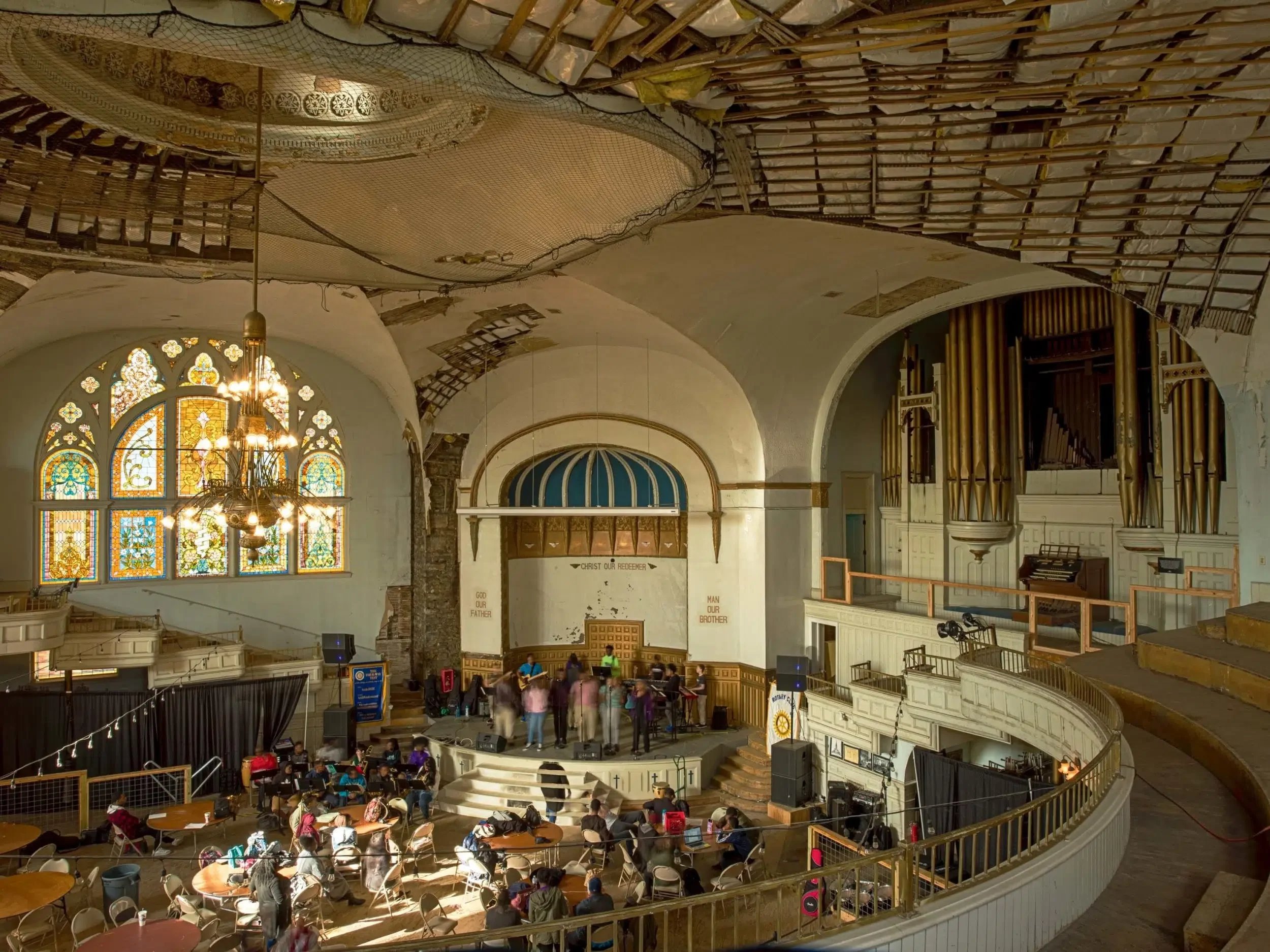
In 2015 her nonprofit organization, The BIG We, purchased an abandoned church near downtown Memphis, with a plan to renovate it and make it into a center of culture and community — as well as an important historic site.
Troutman and her team spent several years and roughly $10 million restoring the church, Historic Clayborn Temple. Built in 1892, the church originally had an all-white congregation. By 1950 the white congregation had left and the church had become a center of the local Black community, and of civic activism.
“The church became known as one of the spaces in Memphis that was sympathetic and open to organizing work, which not all Black churches were,” says Troutman. “We think about civil rights [and Black churches] as inextricably linked, but it’s actually not true. There were very few Black churches that were willing to have the courage to step up and be in spaces like this. So it became sanctuary not only for spiritual work but also for [civic] and social work.”
In 1968 Clayborn Temple gained national notoriety as an organizing hub for the Memphis sanitation workers’ strike. The strike focused on the very different working situations for white and Black sanitation workers, in terms of pay, conditions, and basic work rules. The strike was called after two Black workers who sat in the back of a sanitation truck to seek refuge from the rain — they were not allowed to ride in the cab — were killed when the truck malfunctioned. Dr. Martin Luther King Jr. came to Memphis to support the workers and help lead a protest. The workers famously carried signs reading simply “I AM A MAN” to protest what was viewed as inhumane treatment. The signs were printed in the basement of Clayborn Temple.

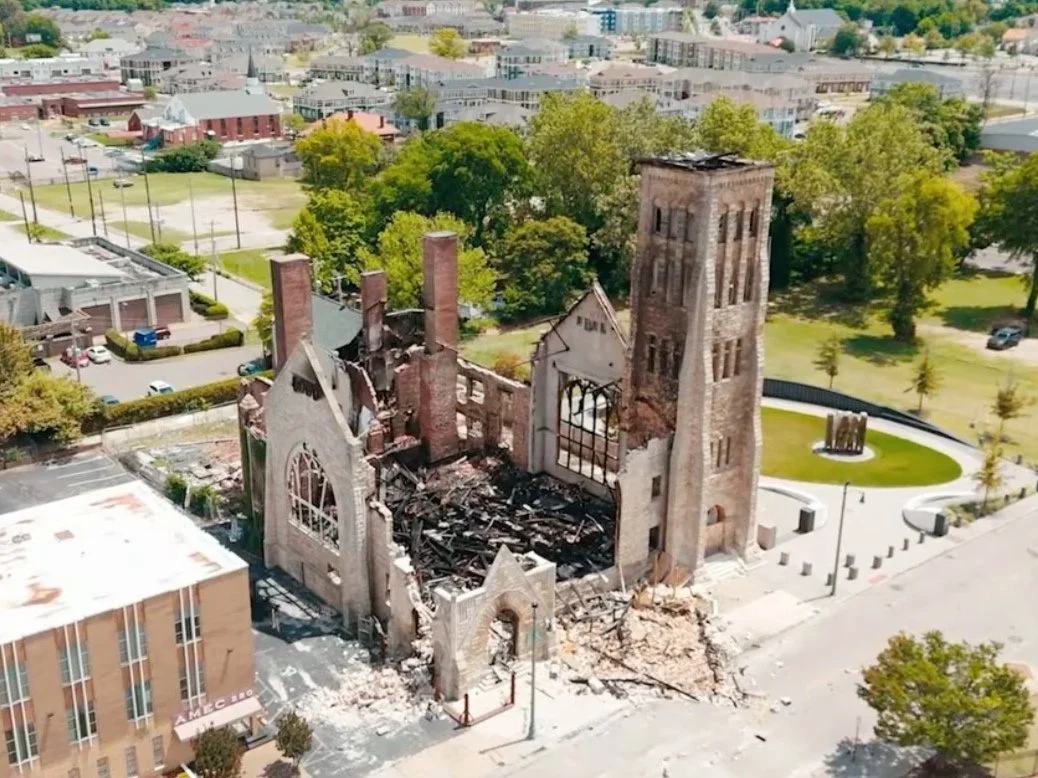
Heartbreak struck in the early morning of April 28, 2025. A devastating fire gutted a large portion of the building, including the sanctuary. It was arson.
Troutman watched the church burn for 15 hours. “I felt almost like I did when my father was dying,” she says. “I was with him in the hospital, holding his hand and talking to him, and I felt the same compulsion to stand there and bear witness to the building’s demise.”
Dozens of people came to take in the scene. Many stopped to express their grief at a memorial wall on the grounds commemorating the striking sanitation workers. “They would walk up to the wall and just crumble or cry or scream or wail,” says Troutman.
“I think that there is a lot of physical pain, personal pain just because of people’s attachment [to the building and its history], but there is also this more ancestral pain that is being triggered by this event because of our experience and relationship to burning churches in the South, specifically with Black congregations,” she says.
Although police published a photo of a “person of interest” a month after the fire, no arrest has been made.
What Comes Next?
Anasa Troutman, by her own admission, has never been one to settle down and take things as they come. She sees possibilities and she pursues them, sometimes with a single-mindedness. There was never a question about her desire to rebuild. “Our construction and design team was on site while the building was still burning,” she says.
A month later, at a press conference on the Clayborn Temple grounds attended by Martin Luther King III, the African American Cultural Heritage Action Fund announced a $1.5 million grant toward reconstruction.
In April 2026 the Big WE hosted a two-day conference called Reimagine Memphis. It brought together leaders in philanthropy, culture, preservation, economic development, and civic innovation. They discussed visions for the future of Memphis and the role Clayborn Temple would play as a center of culture and community. Positivity and good feelings were high.
On the one-year anniversary of the fire, Troutman announced that $8.5 million had been raised and a plan is in place to open a section of the building in 2028, in time to commemorate the 60th anniversary of the assassination of Dr. King. Restoration is underway.
“The whole point of the sanitation workers and the declaration of these workers to say ‘I am a man’ is about declaring their own dignity, declaring their self-determination, their right to have a say in their life.””
Still, there’s a long way to go. The plan for the site is three-fold:
An immersive experience that tells the story of the strike through artifacts, live reenactments, and more
A performing arts and gathering space seating 500 people, located in the sanctuary
An innovation lab for culture and economy, aimed at entrepreneurship, business development, and the arts
The fundraising goal is $75 million.
Troutman’s vision for Clayborn Temple has always been centered on economics.
“Access to self-determination is really at the core of what I think our work is about,” she says. “Poverty means that you don’t have control over how you build your life for yourself, your family, and your community. …It means that you don’t get to decide what you eat, where you live, how you dress, whether you go on vacation, where your kids go to college, or whether they do or not….
“The whole point of the sanitation workers and the declaration of these workers to say ‘I am a man’ is about declaring their own dignity, declaring their self-determination, their right to have a say in their life.”
Memphis, once the center of the American cotton trade, remains troubled economically. The city is highly segregated. Its population is 63 percent Black, the poverty rate among the Black community is 46 percent, and business ownership is notably low. However, says Troutman, “Memphis is not just about the poverty of Black people. It’s about the poverty of systems and how it can affect people across the board. Because when you go without, at some point I’m going to suffer, too.”
Dr. King believed that class and economic exploitation are important elements in any discussion of civil rights. He was assassinated in Memphis on April 4, 1968, just a week after the initial I AM A MAN march and half a mile from Clayborn Temple.
Troutman’s message, and the plan for Clayborn Temple, honor not just his memory but his work and goals.
“For me, memory is most important when it’s activated into the future,” says Troutman. “I’m preserving stories because I want people to understand the blueprint to gain your own self-determination.”
More: Anasa Troutman participated in the 2025 cohort of Widen the Circle’s Berlin Fellowship and Summer Forum. Watch the keynote discussion where she speaks about the fire, her vision, motivation, and hopes for the future.