
“Be courageous, be creative…make a difference”
Teacher Sandra Butsch inspires students with her passionate and creative approach to remembrance
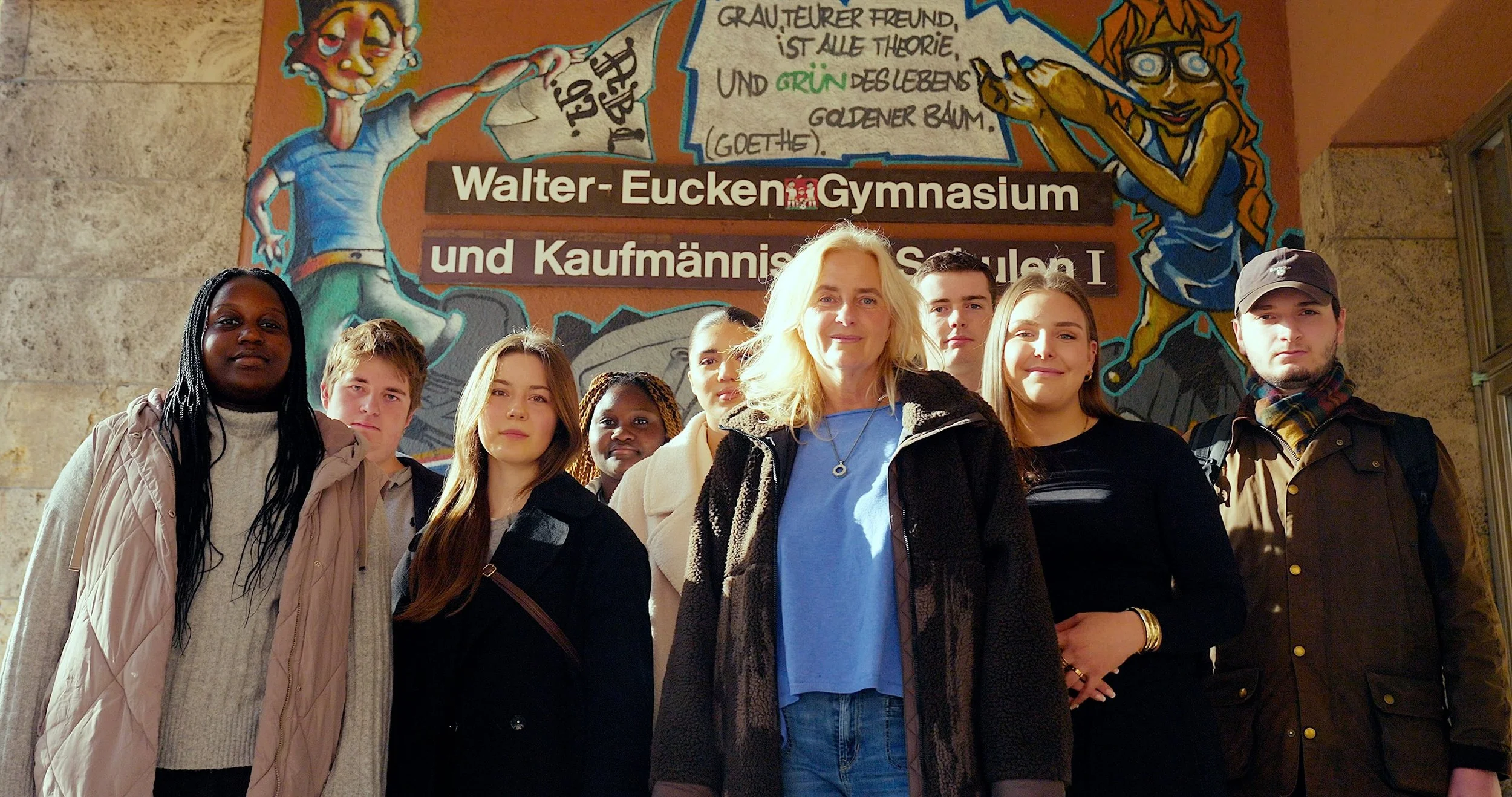
The word “people” keeps coming up when you talk to Sandra Butsch. A teacher in Freiburg, in southwestern Germany, she has initiated countless projects that bring students together and help them learn about history, with all its flaws.
“People. When I work with people, when I look at people’s individual fates, when I engage in conversation and look for and find encounters, then something human always comes up,” she says.
And she’s dealt with a lot of people and a lot of projects. As a teacher on numerous academic levels — including elementary, middle, and high school, as well as vocational training schools and special education programs — Butsch has sought to bring history to life for her many students through her work to combat antisemitism and racism.
Always on a project
From the beginning, Butsch has always engaged in memorial and remembrance projects and political education with her students. Many have encompassed cross-border topics with France, which is just a few miles away from Freiburg.
It is logical to have a lot of projects with France, she says. In addition to proximity, she is fluent in French and her students often cross the border, particularly to go shopping in Strasbourg, the capital of the French Alsace region roughly an hour away.
And France represents something else for her, related to her long-time interest in fostering better relations in the Middle East. “For me, German–French history is a straw, hope, a lifeline,” she says. “After centuries of war, something clicked at some point. It is not a guarantee for eternity, but something clicked.” At some point, the two sides saw the possibility for cooperation. It was a situation not unlike the current Middle East, she says. So there is hope.
“In my life so far, I have met very few people who are as selfless and committed as she is”
Overall, Butsch is a naturally optimistic person. “I have experienced so much good in my life that I can only be optimistic and hopeful,” she says. She was born in a small village in the Junge Donautal (Young Danube Valley) region near the source of the Danube River in the state of Baden-Württemburg. She began her professional career as a journalist, working in German television behind the scenes after majoring in German and political science.
Then a friend asked Butsch to accompany her to an interview for a teaching position, and she agreed. The interviewer ended up convincing Butsch to be a teacher. For a bit she worked as both a journalist and a teacher before switching to teaching full-time. Currently, she teaches social studies, history, German, and ethics at the Walter Eucken Schools (Walter-Eucken-Gymnasium Kaufmännische Schulen) in Freiburg.
The French projects
For one of her projects, she traveled with students to the Gurs detention camp north of the Pyrenees mountains in France. Among the first and largest French internment camps, it was opened before World War II, initially built for political refugees from Spain and former combatants of the Spanish Civil War.
The camp is especially significant for students living in Freiburg because nearly the entire Jewish population from the Baden region, where Freiburg is located, was deported there. Those who survived the camp’s harsh conditions were deported to Auschwitz starting in 1942.
The students created a graphic novel, A Journey to Gurs (Eine Reise nach Gurs). It features eyewitness accounts and also gives current-day perspectives from the young people who participated in the trip as they gained a new understanding of history. QR codes provide access to videos and audio files for those who want to do more research.
Another project that is currently ongoing is a German–French collaboration at the Blue House in Breisach, which sits on the German side of the Rhine River. France lies just across the bridge, some 930 feet (283 meters) away.
The house serves as a commemoration and education center about Jews in the region. Butsch’s project involves 23 schools from both sides of the river and engages them in learning about the Jews who lived there.
The bilingual project, called Bridge for the Future, involves more than 380 students in researching persecuted people from the region. The students learn how to conduct research and interviews and how to work with biographical material. They turn their efforts into graphic novels.
Butsch also has a long-standing relationship with Israel going back to 1998. She has visited there many times, as have her children. And she has organized numerous exchange programs with schools both inside Israel and in the West Bank, including with the German international school Talitha Kumi in Beit Jala, near Bethlehem.
In fact, a group of Israeli students was set to visit Freiburg just days after the October 7 Hamas terrorist attack in 2023, but had to cancel as many were then called up for military service.
Reaching students where they are
Drawing, graphic novels, podcasts, film, rapping – these are mediums that appeal to young people, so as a teacher, it is important to meet students where they are, says Butsch. The different mediums also encourage creativity and learning new skills – such as video and audio editing, and how to write for something more than the page.
“I always have concrete problems” she says, “but then I have to find a personal point of entry” for the students. That’s why she uses so many different mediums. Some students respond better to drawing, others to videos, and still others to music.
Butsch’s work has inspired professional admiration. Her nomination for an Obermayer Award was supported by four past Obermayer Award winners, all teachers: Norbert Giovannini, Angelika Rieber, Roswitha Weber, and Margit Sachse. They wrote:
“As former and practicing teachers, Sandra Butsch is both a role model and a source of hope for us. In everything she does, she combines a deep humanity and closeness to young people with professional competence and an impressive wealth of ideas….
“Beyond the normal commitment of a teacher, she creates real and intense encounters: with local and regional Jewish communities, at Stolperstein [memorial stumbling stone] events, in discussions with contemporary witnesses and artists, in cooperation with organizations and institutions involved in remembrance work, and increasingly in the context of German–French and Baden–Alsatian remembrance work.”
Giovannini later added, in an interview: “The biographical work that she does is highly effective.” Butsch does impeccable research and is careful to show the realness and humanity of people, he says. “And to combine this with such an aesthetic project as the graphic novel or the accompanying films, I think that’s the value, the incredible value of this combination of research — the way the biographies are presented — and then the artistic representation.”
Student reaction
Butsch is passionate about helping students. “What I want to impart to young people,” she says, “is be courageous, be creative…make a difference.”
Many of Butsch’s students say she has changed their lives.
“She gave us students the space to develop our still-young personalities, form our own opinions, and gain new perspectives,” says Joël Bauer, a former student. “With her zest for life and empathy, her commitment and political activism, she showed me a completely unknown world—a world in which teachers can also be friends and critical thinking is encouraged rather than stifled.”
He labelled his time at the vocational school where Butsch then taught as “a defining moment in my life.”
Max Regnath, who also attended the vocational school, said Butsch’s German–Israeli student exchange program, which he was a part of in 2015, inspired him to do international volunteer work in Israel after high school.
He visited Israel three times on his own after that project and developed good friendships there, he says. “Sandra Butsch was and is not only a passionate teacher but also a person who lives and breathes social responsibility,” Regnath notes, adding that Butsch fights prejudice and intolerance not only on the job but in her private life as well.
He credits her with being able to accept people for who they are. “She let you develop on your own terms, without being judgmental,” he says. Butsch spoke to her students as a group whereas often in Germany a teacher will stand up in front of the class and talk to the students — not with them, he says.
The connection she created was so powerful that his class formed an alumni group and they get together every Christmas. They are even planning a trip next year to celebrate the 10th anniversary of their graduation. While the destinations are not set in stone, the group might return to either Lisbon or Crete — places they traveled to with Butsch during their final year in school together.
Former student Julian Würth feels privileged that he got to work with Butsch.
“In my life so far, I have met very few people who are as selfless and dedicated as she is,” says Würth. “For her, it was never ‘just’ a school project; there were always several projects running at the same time, and to this day, I still don't understand how she managed to do it all.”
Würth, who now studies nonprofit management at the University of Freiburg, stressed that even when a project did not receive the needed funding, Butsch would dig into her own pocket to fund it. She enabled her students to refine their view of the world and feel history – while at the same time having fun with a project.
“If I had one word to describe her, I’d say persistent,” he says, adding that she is stubbornly driven to achieve her goals. Anyone who has the privilege of working with Butsch is really lucky, he concludes.
— Obermayer Award recipient 2026