
Transforming a former Gestapo headquarters
The Hotel Silber Memorial and Learning Center provides important lessons about democracy and remembrance
by Toby Axelrod
When Heinz Hummler was 12 years old, in 1944, he wrote a letter pleading for the life of his father.
The Gestapo had arrested Anton Hummler in 1943 as a member of a communist resistance group that had listened to forbidden foreign radio broadcasts and planned to smuggle the German Jewish dentist Walter Glaser to safety in Switzerland.
Anton Hummler was held in the Gestapo headquarters at the former Hotel Silber, an imposing, ornate 19th century structure on Dorotheenstrasse 10 in Stuttgart.
“From that time on, my life and my worldview, insofar as a small boy can have one, changed completely,” Heinz Hummler, 93, says.
His letter didn’t work. His father was executed on September 25, 1944 in Berlin. During the Nazi era the building was the first stop on a journey through prisons and concentration camps, usually ending in death. Today, the building has been preserved and is home to the Initiative Hotel Silber Memorial and Learning Center.
Since 2018 the former luxury hotel of Heinrich Silber, which became a police station in 1928 and served as Gestapo headquarters for what was then the state of Württemberg and Hohenzollern from 1933-1945, has housed a multimedia exhibition about this history. The exhibition traces the development of the police from democracy to dictatorship, and highlights the need to protect democratic norms and embrace diversity in society.
“The Nazis did not establish their dictatorship through the military but through the police,” says Elke Banabak, managing director of the Initiative Hotel Silber Memorial and Learning Center.
The center is a nonprofit association and operates in a cooperative partnership with the House of History Baden-Württemberg, a Stuttgart history museum. Hotel Silber provides training for educators and police officers, and has initiated a visual and performing arts project inspired by the biographies behind local Stolperstein (stumbling block) memorials. It has a staff of three, though most projects are run by volunteers.
The exhibit includes excerpts from diaries and letters as well as audio interviews with eyewitnesses, both perpetrators and survivors. Guest lectures, communal events, film screenings, and school visits round out the offerings.
Police training
Local police trainees are required to visit the center, where they learn how the Nazis turned the police force into a tool of oppression. They ask: “How did those in charge handle it at the time?” says Thomas Ulmer, 63, a recently retired officer with the Stuttgart police who has led numerous groups through the exhibition.
Police trainees grapple with conclusions they can draw from the past, including when it is justified to disobey an order, says Ulmer, who fought alongside pro-democracy groups to preserve the Hotel Silber and is active in a national advocacy organization for LGBTQ+ staff in the police and justice system.
The Gestapo would act “without an arrest warrant, simply take people from their homes and, if we’re talking about the Jewish population, ultimately deported them,” he says. “Those are classic questions young people ask: Who ordered this? How did it all come about?”
Such discussions are especially important given recent scandals, he says. “Far-right, extremist material was shared by police officers and trainees via WhatsApp chat groups. After this came to light, all the police forces in Germany, including the federal police, asked themselves: What must we teach our trainees, and also those long out of training, about democracy?” says Ulmer.
“What must we teach our [police] trainees, and also those long out of training, about democracy?”
In Stuttgart, the Hotel Silber Memorial and Learning Center provided answers.
Meanwhile, a collaboration with students from Stuttgart’s Johann Friedrich von Cotta High School has made waves at Hotel Silber. A new exhibition, Gestapo on Trial, includes reflections by German and Ukrainian teenagers about war crimes, responsibility, and accountability. The students conducted research in 2023 and interviewed, among others, a prosecutor of the 1960s Frankfurt Auschwitz trials of perpetrators. The teens asked themselves, among other things, whether Russians might eventually be prosecuted for war crimes against Ukrainians.
Saving Hotel Silber
Hotel Silber “showed me how fluid the boundary between a democratic and a dictatorial system is at the beginning of the process,” says Zoltan Igaz, chair of the Federal Association for Information and Counseling for Victims of Nazi Persecution. “And it is also a place of desk perpetrators” — officials who, with a swift signature, decided between life and death.
Eyewitnesses like Hummler have often met with young guests at Hotel Silber, holding open the curtain on history.
Unfortunately, says Hummler, “the process of forgetting began with us [Germans] just a few months after the end of the war.”
In fact, the past of Hotel Silber was nearly buried, literally. For decades after the war, it housed various governmental offices. Then in 2008, the city of Stuttgart proposed tearing it down to make way for a shopping center.
“Many persons and organizations got together to fight for the Hotel Silber,” says Brigitte Lösch, a legislator in the state parliament of Baden-Württemberg from 2001-2021. Today she chairs the Hotel Silber Memorial and Learning Center, and works privately as moderator and mediator. “Authentic buildings are very important for historical learning,” says Lösch. Born in 1962, she grew up about 60 kilometers from Stuttgart in Geislingen, where she campaigned to preserve the sites of former slave labor camps. So she came to this new fight with experience.
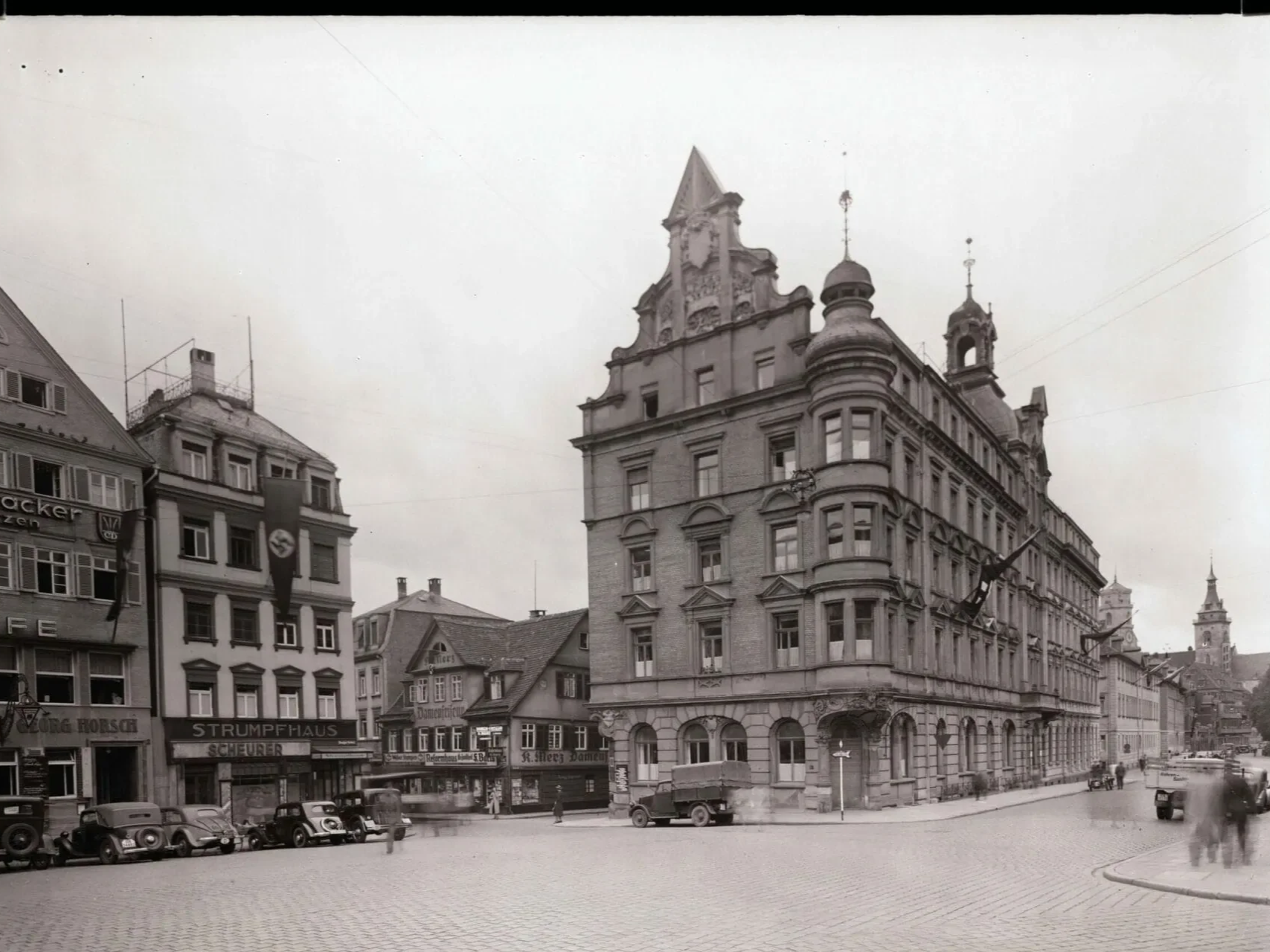
Historic photo of Hotel Silber
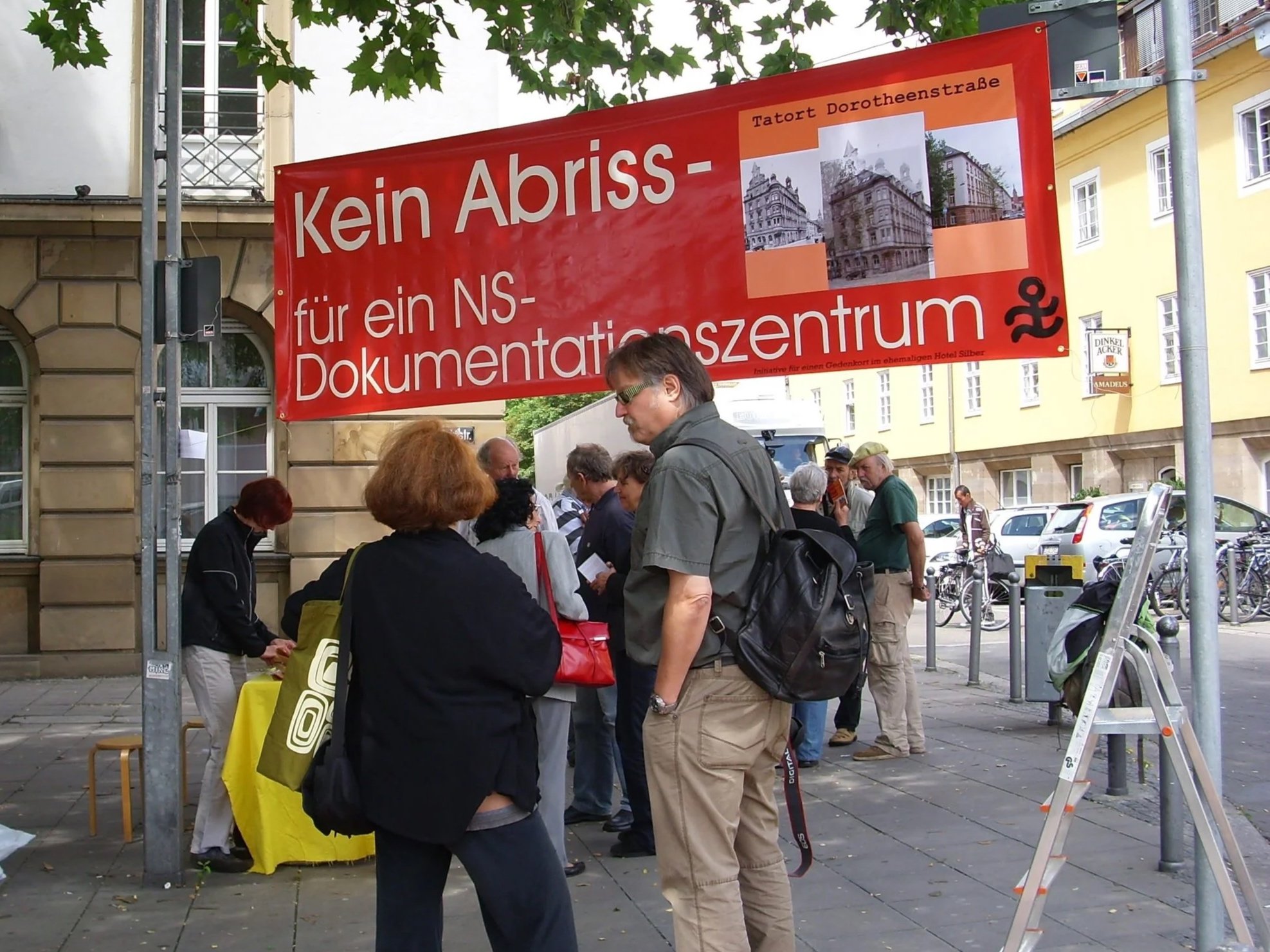
“No Demolition” — the effort to save the Hotel Silber building
“There were lots of opponents,” she recalls. “Some said a shopping center should go there because it will bring in money. Others said you can do remembrance culture anywhere — a plaque is enough; you don’t need the whole building, it’s not that important.”
She and others enlisted the help of people with a connection to the history, including Hummler and his late wife Heidi, members of the Association of the Persecuted of the Nazi Regime – League of Antifascists (Vereinigung der Verfolgten des Naziregimes – Bund der Antifaschisten).
They were “with us in front of the building, protesting against its demolition,” says Elke Banabak, managing director of the Memorial and Learning Center.
An architect by training, Banabak is “interested in the things that memory does to places, how memory becomes attached to places.” In the early 2000s she met and interviewed survivors of a satellite of the Natzweiler concentration camp. From then on, she felt personally connected to this history.
Another native of Stuttgart, Charlotte Isler, nee Nussbaum, soon joined the campaign to save the Hotel Silber. Today 101 years old, she lives near New York City.
“I wrote probably the freshest letter I ever wrote to anybody,” and sent it to the local mayor, and other city and state officials, Islers says. She “explain[ed] to these people that they owed it to history and to the Jewish people who had lived there to preserve it.”
Isler’s recollections of life under Nazi persecution are vivid. Right after the anti-Jewish Kristallnacht pogrom of November 1938, her father was arrested, as were tens of thousands of Jewish men across Germany. Isler and her younger brother were kicked out of school, like virtually all Jewish children, forced to pack up their bookbags while their classmates watched.
“Things just got worse and worse from then on. We couldn't do this, we couldn't do that, and so on and so forth. So of course, I remember every minute of it,” says Isler, whose family managed to flee to the United States in the spring of 1939.
“To my enormous surprise, we won” the fight for the Hotel Silber, she says. “So then the initiative went to work,” turning the building into a place of remembrance. Isler attended the inauguration with her son, Donald. “And as you know, it has become a really remarkable institute.”
“Calling from the basement”
With the battle won, Banabak finally stepped inside the former hotel. “When I first looked down this corridor that we now have inside the exhibition, I got the chills a little bit. But it's nothing but a corridor.”
To either side, there are doors. Behind those doors are offices. “All the bad things, all the atrocities that came from this building, they were thought of in these offices. And also the interrogations took place in the offices,” Banabak says. Witnesses recounted hearing prisoners calling from the basement.
The last person murdered there was a Jewish woman, Else Josenhans nee Meyer, on April 11, 1945 — about a month before Germany capitulated. She was arrested in January 1945, during a failed attempt to escape the country.
The story of Hummler’s father becomes vivid through the framed plea for mercy. “I imagine the boy writing this letter at a table in the kitchen,” says Banabak. “He actually wrote to the chief of the Hitler Youth because he thought that would be someone who could help his father. It's very neatly written in his boyish handwriting, and it's signed Heil Hitler.”
A copy of Anton Hummler’s last letter to his family is also on display.
Today, Banabak’s office is in the hotel. “And when I stay long hours and there's no one left here in the building, well, it can be a little bit scary,” she says.
“It’s very difficult to imagine all of it,” says Hummler, who describes himself as “an entirely rational person — someone who always tries to look for the reasoning behind things.”
When he shows pupils his framed letter, he tells them why he signed off as he did. In post-war Germany, this and all trappings of the Nazis are illegal. But during the Nazi regime, a failure to show fealty could be fatal.
“At that point I already knew that killing my father — and many, many other resistance fighters and people in an organized, utterly inhumane way — was a crime,” he tells his young visitors. “But I would have written ‘Heil Hitler’ three times if it could have saved my father’s life.”
— Obermayer Award recipient 2026